Tuesday, 2 May 2017

Saturday, 22 April 2017
Tuesday, 28 March 2017
Wednesday, 15 March 2017
Thursday, 2 March 2017

Friday, 24 February 2017
Music Video Second Draft
Things we need to add and improve on:
- Shorten the girl's bedroom scene, which goes on too long with too many unnecessary shots.
- Arrange the cuts so the film is more in time to the music.
- Recreate the opening with a shot of the corkboard to clarify the use of the photographs
- Use a shot of the bridge photograph on the corkboard instead of just cutting to the photo
- Fade out the music at the end
- Shorten some of the beach shots to make the ending more concise
Thursday, 23 February 2017
Wednesday, 22 February 2017
Characters
Our music video centres around two main protagonists.
The male character, Samuel, played by Louis Coles, is a typical teenage boy created to portray millennial youth, therefore appealing to our target audience. The character's name was based on the artist Samuel Ford himself, with the intention of further establishing his 'brand'.
Samuel wears a beige jacket, jeans and trainers; a typical appearance for a modern teenager. We first see him in his bedroom which, again, is styled as a traditionally 'boy-ish' room.

The second protagonist is Lucy, played by Saffron Casbourne. The name 'Lucy' is inspired by Lucy Rose, a prominent artist in the genre 'Kings' belongs to.
Lucy is seen throughout the video wearing a pink jumper, which highlights her innocence and femininity, with pink being stereotypically associated with girls. The camera rarely centres on Lucy's face, leaving her as an enigma to the audience.

Our intention with these two characters was to allow the audience to be able to relate with their story. Because they are young people going through relationship issues, we felt many members of our primary target audience (18-25) would identify with the video, having gone through similar struggles themselves.
The video focuses completely on these two characters, allowing our audience to connect with them through spending more on-screen time with them.
The male character, Samuel, played by Louis Coles, is a typical teenage boy created to portray millennial youth, therefore appealing to our target audience. The character's name was based on the artist Samuel Ford himself, with the intention of further establishing his 'brand'.
Samuel wears a beige jacket, jeans and trainers; a typical appearance for a modern teenager. We first see him in his bedroom which, again, is styled as a traditionally 'boy-ish' room.
The second protagonist is Lucy, played by Saffron Casbourne. The name 'Lucy' is inspired by Lucy Rose, a prominent artist in the genre 'Kings' belongs to.
Lucy is seen throughout the video wearing a pink jumper, which highlights her innocence and femininity, with pink being stereotypically associated with girls. The camera rarely centres on Lucy's face, leaving her as an enigma to the audience.
Our intention with these two characters was to allow the audience to be able to relate with their story. Because they are young people going through relationship issues, we felt many members of our primary target audience (18-25) would identify with the video, having gone through similar struggles themselves.
The video focuses completely on these two characters, allowing our audience to connect with them through spending more on-screen time with them.
Tuesday, 21 February 2017
Premise and shot locations
The concept for our music video follows a classic three act structure, with an inciting incident and resolution.
The video opens with the male character, Samuel, in his bedroom looking at an unseen photograph. As the music progresses, Samuel gets up and leaves his house and begins walking to an unknown destination.

We wanted to choose a bedroom which represented the character of Samuel. To do this, we chose Isaac's room which has a blue colour scheme and has football shirts hung up on the wall, which is typically masculine.
The second scene is similar to the first, reflecting that the two characters are fated to be together. The girl, Lucy, is alone in her bedroom when she finds an old anniversary card, implying it was given to her by the male character. This upsets her and she, too, leaves the house to go to an unknown destination.

Similarly, we wanted a typically feminine bedroom for the character of Lucy so we have decided to use Saffron's own bedroom, which contains objects such as a hairbrush and mirror to use as props.
As the next verse plays, leading into the first chorus, the boy walks through the street (the camera is always following him as he walks to the left).
The girl also walks down a street (the camera following her walking to the right, to give the implication that the characters are walking towards each other) and sees a statue near a park. There is some sort of transition into a picture showing the couple together here - a flashback to their former love.


The street is quite an industrial, cold area and so we chose to use this as a location to convey the state of the protagonists' relationship. As the video progresses, the imagery will become more natural and warm.
We have decided to use the large red statue on Mariot's way because it is a notable landmark that will be easy to come back to during filming.
There is a transition to the boy travelling through a forest or woods, and the girl also walking through a similar location. The girl stops at some sort of landmark and there is another flashback to the couple together at that landmark.


Forest locations were chosen because often in music videos of the same genre, natural imagery is featured. This is because the original form of music it descends from - folk music - originated from people singing and composing songs about nature. We decided to use these particular locations because, importantly, they were places which all of our cast and crew could easily travel to and also because we were already familiar with the layout of the parks, so knew specific locations which would be good for filming.
As the instrumental and outro play, the couple reunite at a beach and hug. The photo the boy was looking at is revealed to be a photograph of the couple at that very same spot on the beach. They walk away together and the video fades out.

This particular beach, Wells, was chosen mainly due to the beach huts. Beach huts allowed us to have a landmark which the two characters could meet at, meaning that the audience will not have to suspend their disbelief that the two just happened to walk to the same indiscernible spot on a huge beach. The boy walked to the exact beach hut that he and the girl are seen together near in the photograph, and we can assume that the girl has done the same, remembering their spot.
ACT 1
The video opens with the male character, Samuel, in his bedroom looking at an unseen photograph. As the music progresses, Samuel gets up and leaves his house and begins walking to an unknown destination.
We wanted to choose a bedroom which represented the character of Samuel. To do this, we chose Isaac's room which has a blue colour scheme and has football shirts hung up on the wall, which is typically masculine.
The second scene is similar to the first, reflecting that the two characters are fated to be together. The girl, Lucy, is alone in her bedroom when she finds an old anniversary card, implying it was given to her by the male character. This upsets her and she, too, leaves the house to go to an unknown destination.
Similarly, we wanted a typically feminine bedroom for the character of Lucy so we have decided to use Saffron's own bedroom, which contains objects such as a hairbrush and mirror to use as props.
ACT 2
As the next verse plays, leading into the first chorus, the boy walks through the street (the camera is always following him as he walks to the left).
The girl also walks down a street (the camera following her walking to the right, to give the implication that the characters are walking towards each other) and sees a statue near a park. There is some sort of transition into a picture showing the couple together here - a flashback to their former love.
The street is quite an industrial, cold area and so we chose to use this as a location to convey the state of the protagonists' relationship. As the video progresses, the imagery will become more natural and warm.
We have decided to use the large red statue on Mariot's way because it is a notable landmark that will be easy to come back to during filming.
There is a transition to the boy travelling through a forest or woods, and the girl also walking through a similar location. The girl stops at some sort of landmark and there is another flashback to the couple together at that landmark.
Forest locations were chosen because often in music videos of the same genre, natural imagery is featured. This is because the original form of music it descends from - folk music - originated from people singing and composing songs about nature. We decided to use these particular locations because, importantly, they were places which all of our cast and crew could easily travel to and also because we were already familiar with the layout of the parks, so knew specific locations which would be good for filming.
ACT 3
As the instrumental and outro play, the couple reunite at a beach and hug. The photo the boy was looking at is revealed to be a photograph of the couple at that very same spot on the beach. They walk away together and the video fades out.
This particular beach, Wells, was chosen mainly due to the beach huts. Beach huts allowed us to have a landmark which the two characters could meet at, meaning that the audience will not have to suspend their disbelief that the two just happened to walk to the same indiscernible spot on a huge beach. The boy walked to the exact beach hut that he and the girl are seen together near in the photograph, and we can assume that the girl has done the same, remembering their spot.
Wednesday, 18 January 2017
Tuesday, 17 January 2017
Tuesday, 20 December 2016
The Suburbs Narrative Analysis
Anticipation and Closure
The music video for The Suburbs by Arcade Fire builds up an increasing sense of foreboding and brutality throughout; the kids play with guns, they playfight and the police state becomes more and more prominent as the story progresses. The audience expects something terrible to happen in the video's climax, and this is delivered to us when the protagonist is beaten up by his best friend in the restaurant.
The film relies heavily on proaretic codes: the multiple shots of bikes act as a platform to drive the narrative forward, as do the images of the characters playing. This all builds up to the climax of the video; the bikes, which represent childhood and innocence, are undermined as a symbol when the protagonist finds his bike vandalised and broken outside his place of work. This is a symbolic code which also acts to move the story forward - it forebodes the danger coming up in the finale.
The music itself also provides anticipation with its different cadences. The audience expects where the song will go next, and its standard structure provides the audience with their expectation. However, the music throws the audience off balance with the omission of a middle eighth, which is a very common element of modern music. This reflects the video which becomes increasingly darker as it progresses, and the viewer is therefore confused and unsettled by the lack of a middle eighth.

The music itself also provides anticipation with its different cadences. The audience expects where the song will go next, and its standard structure provides the audience with their expectation. However, the music throws the audience off balance with the omission of a middle eighth, which is a very common element of modern music. This reflects the video which becomes increasingly darker as it progresses, and the viewer is therefore confused and unsettled by the lack of a middle eighth.
Narrative Strands
The Suburbs contains multiple 'narrative strands', which are interweaving themes and elements within one overarching story. Narrative strands allows for the director of the video (Spike Jonze) to build and establish different characters and their relationships/stories.
The most prominent narrative strand is the relationship between the two boys (Winter and Kyle). Their friendship is built up at the beginning of the video, allowing the viewer to assert that they have a strong bond and are loyal to each other. However, the friendship deteriorates throughout the video leading to the violent climax.
Another strand is the relationship between the boy and his girlfriend (Winter and Zoe). Similar to the boys' friendship, the video establishes their relationship and tells us that they really care for each other. Similar again to the other narrative strand, their relationship breaks down and there is a shot implying that they have just broken up with each other.
Along with the strands regarding the characters and their relationships, there are narrative strands which outline overarching themes. For example, childhood and innocence is represented throughout the video using the symbolic and proaretic codes of bikes. At the video's climax, the bike is destroyed, representing the loss of innocence and the process of growing old.
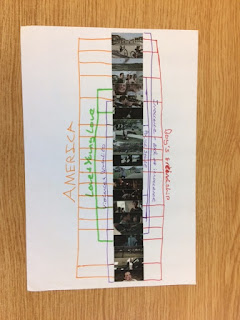


This shows each scene which features a certain theme. The boys' friendship is a very common strand within the video, as is the broad theme of America and youth/innocence.

This diagram shows the amount of a strand in certain scenes. In certain shots, such as the boy and girl underneath the underpass, young love is the dominating strand - whilst in others the boys' friendship is very prominent.
Todorovian Structure
The Suburbs can be analysed using Todorov's 3 act structure.

Friday, 16 December 2016
Monday, 12 December 2016
Wednesday, 19 October 2016
Narrative structure in 'Everybody Hurts'
Everybody Hurts
R.E.M.
In
REM’s music video for ‘Everybody Hurts’, a linear narrative structure is
featured which can be examined using Todorov’s three act structure theory. The
setting of the video is a highway with cars moving (the equilibrium) and
throughout this first act different characters are introduced. The inciting
incident occurs as the traffic stops, leading into act 2’s disequilibrium (the
singer leaving his car and walking). This is typical of three act narratives
according to Todorov, which always follow a very similar structure. In act 2 of
the video, the narrative finds its resolution when all the characters leave
their cars and begin walking with the singer; this carries on into act 3, where
the characters walking becomes the new equilibrium. Using Todorov’s concepts,
it can be assumed that this video features a successful three-act structure
narrative and succeeds at telling the story it sets out to tell.


End of Act 1 End of Act 2 End of Act 3
However,
at the end of the video there is a separate conclusion in which the music stops
playing and we hear the voice of a news reporter claiming that all the people
in the video ‘just got out and walked’ and that ‘they cannot find anyone’. This
does not fit exactly with Todorov’s concepts, as although this could be seen as
a ‘resolution’ to the narrative, it is featured after act 2 and 3, and is
presented as a very short fourth act.

Narrative
devices are used very effectively in this music video, the most significant being
the use of subtitles as an expression of the characters’ thoughts. These subtitles
allow for the audience to better understand the characters and the story,
without the need for diegetic sound overlapping the music. At the beginning of
the video, the subtitles appear to simply mimic the lyrics; however, it soon
changes to the thoughts of a child saying “They’re all stuck.” I find that
using this as the first non-lyric subtitle is an interesting and significant
choice; it provides impact as it frames the narrative and tells us immediately
that something is wrong with the characters. They’re stuck physically in the
traffic jam, but they’re also stuck metaphorically within their own sadness and
emotions.


Another
narrative device used is the car’s window screens themselves. The windows
represent an impassable barrier to the outside world, which all the characters
are trapped behind to represent their disconnection and dissatisfaction with
life. This works as a narrative device because the audience can see from the
start of the video that Stipes and the band are trapped in a claustrophobic and
colourless space.
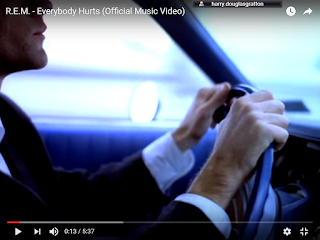

The
video can be analysed using Barthes’ concepts of proairetic, enigmatic and symbolic
codes. Within the narrative, proairetic code is most relevant; proairetic is
defined as an opening of an action which makes the audience want to see closure
of – in this case being the depression and sadness of the characters being
portrayed through subtitled inner-dialogue. The audience wish to see a
resolution to the different characters’ problems, which is indeed given at the
climax of the video when all the characters leave their cars and begin walking
together (symbolic of how the depressed characters “are not alone”).


Tuesday, 18 October 2016
Subscribe to:
Posts (Atom)