Wednesday, 19 October 2016

Narrative structure in 'Everybody Hurts'

Everybody Hurts
R.E.M.


In REM’s music video for ‘Everybody Hurts’, a linear narrative structure is featured which can be examined using Todorov’s three act structure theory. The setting of the video is a highway with cars moving (the equilibrium) and throughout this first act different characters are introduced. The inciting incident occurs as the traffic stops, leading into act 2’s disequilibrium (the singer leaving his car and walking). This is typical of three act narratives according to Todorov, which always follow a very similar structure. In act 2 of the video, the narrative finds its resolution when all the characters leave their cars and begin walking with the singer; this carries on into act 3, where the characters walking becomes the new equilibrium. Using Todorov’s concepts, it can be assumed that this video features a successful three-act structure narrative and succeeds at telling the story it sets out to tell.


              End of Act 1                                   End of Act 2                                 End of Act 3


However, at the end of the video there is a separate conclusion in which the music stops playing and we hear the voice of a news reporter claiming that all the people in the video ‘just got out and walked’ and that ‘they cannot find anyone’. This does not fit exactly with Todorov’s concepts, as although this could be seen as a ‘resolution’ to the narrative, it is featured after act 2 and 3, and is presented as a very short fourth act.


Narrative devices are used very effectively in this music video, the most significant being the use of subtitles as an expression of the characters’ thoughts. These subtitles allow for the audience to better understand the characters and the story, without the need for diegetic sound overlapping the music. At the beginning of the video, the subtitles appear to simply mimic the lyrics; however, it soon changes to the thoughts of a child saying “They’re all stuck.” I find that using this as the first non-lyric subtitle is an interesting and significant choice; it provides impact as it frames the narrative and tells us immediately that something is wrong with the characters. They’re stuck physically in the traffic jam, but they’re also stuck metaphorically within their own sadness and emotions.


Another narrative device used is the car’s window screens themselves. The windows represent an impassable barrier to the outside world, which all the characters are trapped behind to represent their disconnection and dissatisfaction with life. This works as a narrative device because the audience can see from the start of the video that Stipes and the band are trapped in a claustrophobic and colourless space.
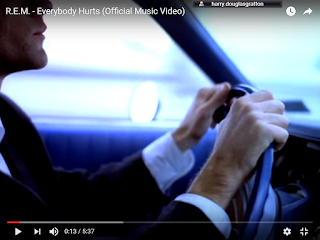


The video can be analysed using Barthes’ concepts of proairetic, enigmatic and symbolic codes. Within the narrative, proairetic code is most relevant; proairetic is defined as an opening of an action which makes the audience want to see closure of – in this case being the depression and sadness of the characters being portrayed through subtitled inner-dialogue. The audience wish to see a resolution to the different characters’ problems, which is indeed given at the climax of the video when all the characters leave their cars and begin walking together (symbolic of how the depressed characters “are not alone”).


Thursday, 13 October 2016

Dialogue in music videos

Some music videos feature dialogue in some form to advance the story and set out a premise. However, to avoid the problem of speaking over the music, many music videos use subtitles to convey dialogue.

Some examples include:


Because our music video is about a couple reuniting, we felt that it would be appropriate to include dialogue between the two in some way. This may perhaps be included towards the end of the video, when the two main characters finally meet.

Another way of depicting dialogue would be through the use of on-screen text messages sent from the protagonists to each other.

Image result for texting in films

Image result for texting in films

Image result for texting in films


Image result for texting in films

This is an interpretation of dialogue which we will use more often than just subtitles. This is because the two characters are a distance away from each other throughout the video, so face-to-face dialogue is only possible in the last moments.

Narrative planning

Whilst planning our music video, we drew out a narrative timeline which documents the events of our music video from start to finish; including the times at which each event happens in relation to the song. We created this to ensure that we can accurately film our video (as well as more easily plan locations and events in accordance with the music).

Tuesday, 13 September 2016

Genre Case Study


Genre


The genre of indie folk tends to refer to music produced independently and features melodic verses and 'laid-back' choruses. Indie folk - and its sub-genres - can be identified by its noticeable hybrid of traditional folk music and instruments with more contemporary sounds. While our chosen song contains some elements of indie-pop, it can be best categorised with indie folk among artists such as Ben Howard, Damien Rice and Beth Orton.

Many music videos within the indie folk genre are performance videos, featuring the artist singing to the camera (and may be playing an instrument - usually a guitar). To make our video as conventional as possible, we will likely try to follow these typical features. This is important because, according to Christine Gledhill, 'Genres permit the creation and maintenance of a loyal audience which becomes used to seeing programmes within a genre'. This means that straying too far from convention would be unpopular amongst the indie-folk fanbase.

All genres within the music industry - not just indie folk - use shared characteristics. Gledhill claims that this is so that audiences "can rely on [them] already having knowledge and expectations about the works within a genre." This is achieved through grouping similar sounds and music cultures together so that people can identify more easily with groups and music they like.

This concept links into the creation of music videos as well as the music itself. Because our song is in the indie folk genre, our video will not use characteristics such as satanic imagery and strobe lighting which is commonly found in music videos for death metal (and some other sub-genres of metal and hard rock). As seen in the screenshots above, all from different music videos in the indie folk genre, a convention of indie folk is close-up shots of the artist performing their music. This is a decision made to increase the recognition of the artist so that audiences can better identify them with their music.

However, this does not mean that our music video has to strictly stick to convention. As stated by Nicholas Abercrombie, “The boundaries between genres are shifting and becoming more permeable”. This means that, unlike the past where conventions within music would not mix with contrasting genres, we are becoming more accepting of the merging of different genres and sub genres. For example, in our music video we could use elements of concept imagery which is a convention of experimental/electronic music mixed with the narrative and performance aspects of indie folk.